
The Air Was Never Empty
There was a time when illness was believed to travel through the air itself. Not through contact, but through something unseen, carried in the wind.
The ancients called it miasma: a corruption of the air, invisible yet undeniable. It was not always visible, but it was felt. The air could turn. And when it did, it brought discomfort, sickness, and unrest.
Spring Reveals What We Forgot
Spring has a way of reminding us that this idea was not entirely wrong.
As trees and flowers come into bloom, pollen fills the air. It settles on surfaces, clings to clothing, and lingers in the spaces we occupy. Opening a window, once a source of relief, can quickly become an invitation to irritation.
For many, natural ventilation becomes something to avoid rather than embrace.
Air Must Be Understood
Air, like water, must be understood before it can be managed.
In buildings designed with mechanical ventilation, there is an advantage. Fresh air can still be brought in, but it does not enter uncontrolled. It passes through the air handler, where it is conditioned and filtered before reaching the space.
What was once attributed to miasma, we now understand as particulate. What was once feared, we now design for.
Filtration Is the Decision Point
Every air handler includes filtration designed to capture unwanted particles: dust, mold spores, pollen, and other fine particulates. These particles are small enough to evade notice, but large enough to affect comfort and health.
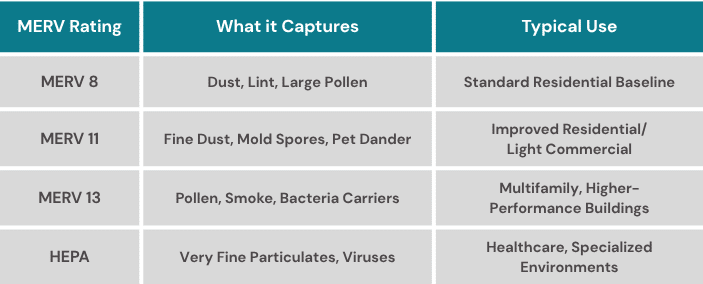
To standardize filtration performance, the industry uses the Minimum Efficiency Reporting Value (MERV), a scale that measures how effectively a filter captures particles between 0.3 and 10 micrometers.
How Filtration Levels Compare
Spring Is Not a Typical Condition
In most residential applications, MERV 8 is a standard. It meets baseline requirements and performs adequately under typical conditions.
But spring is not a typical condition.
As pollen levels rise, the air begins to change. What was once harmless becomes something that lingers, settles, and accumulates. What is acceptable in one season may not be sufficient in another. Increasing filtration to MERV 11 or MERV 13 improves capture of finer particulates, including pollen. With this increase comes the need for greater attention; filters may require more frequent replacement during peak seasons.
What We Allow Inside
What we allow into our buildings matters.
At VP Engineering, ventilation is approached with this understanding built in. Fresh air is essential, but it must be delivered with intention. Filtration is not static. It is seasonal. It is responsive. It is part of maintaining a healthy environment as conditions change.
Adapting to the Air
In the spring, the air shifts. What once brought relief may now bring irritation. Systems that were sufficient may require adjustment. And the difference between comfort and discomfort often comes down to what is allowed to pass through unseen.
Knowledge allows us to adapt.
And as with all things in Stolen Fire, the goal is not to control the elements, but to understand them well enough to shape how they move through the spaces we create.
Next Steps During Pollen Season
- Consider upgrading to MERV 11 – 13 filters during peak pollen months
- Replace filters more frequently than the standard 90-day cycle
- Monitor indoor comfort and adjust as needed
- Return to standard filtration levels once pollen season subsides