
Why Winter Demands Respect for Water’s Behavior
There was once a belief that water was alive in its motion.
Springs and streams endured because they were watched over, kept clear, and allowed to move. Still water was something to fear. Flow meant vitality. Stagnation meant danger. Long before formulas or forecasts, people understood that water demanded attention, not control.
Water still behaves this way.
It flows. It freezes. It expands. It sustains life, and when neglected, it quietly unravels what we have built. None of this is mysterious, but winter has a way of reminding us how easily it’s forgotten.
The Truths Water Teaches
Moving water is less likely to freeze.
Frozen water expands and builds pressure.
Trapped water invites failure.
These simple behaviors shape how our buildings endure cold.
When water flows, it does not linger. Warm and cold volumes mix. Molecules stay in motion. Energy is exchanged. Freezing is delayed. This is why, during extreme cold, people may be told to let a faucet run. It isn’t folklore, it’s an acknowledgment that motion matters.
Our buildings follow the same rule.
When water sits trapped in pipes exposed to freezing temperatures, ice forms. Volume increases. Pressure builds. The rupture feels sudden, but it begins quietly, long before, in stillness.
Running water keeps systems alive.
It preserves motion. It resists freezing. It buys time.
But a dripping faucet isn’t a solution. It’s a signal.
It tells us the system has crossed a threshold; that conditions now require attention. True protection doesn’t come from reaction. It comes from preparation.
Winterization Is Foresight, Not Fear
Winterization means acting before the cold reveals what was ignored.
This includes:
- Insulating piping and exposed lines
- Draining systems when appropriate
- Verifying heat in vulnerable spaces
- Confirming building envelope resilience
This is not fear-driven. It is foresight: an understanding that systems endure not through strength alone, but through care. Water that is allowed to move survives. Water that is ignored does not.
A Myth Worth Remembering: The Naiads
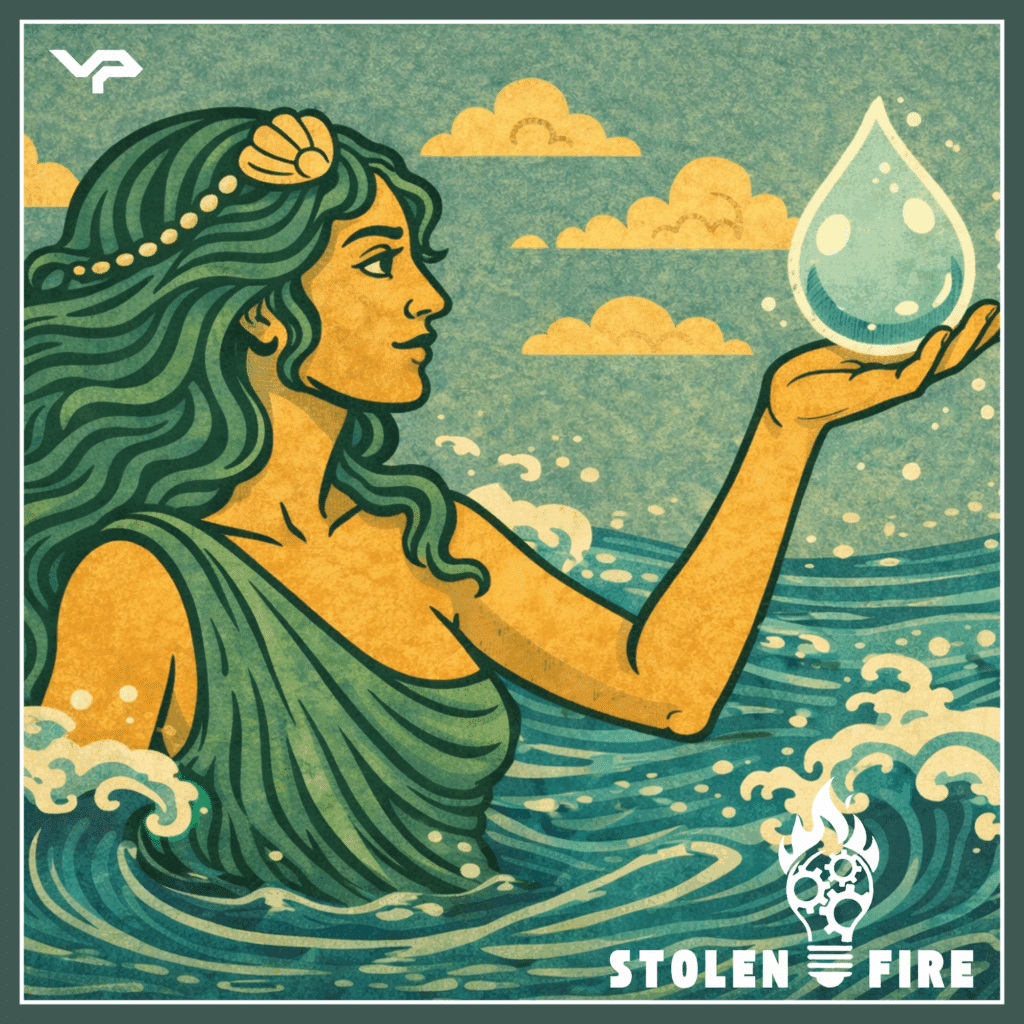
In Greek myth, the Naiads were nymphs of fresh water. When springs flowed clean and free, the Naiads thrived. When water stagnated or was blocked, they weakened and became dangerous. Their story isn’t one of punishment, but of maintenance and attention.
The message is clear:
- Flow preserves life.
- Neglect invites failure.
- Small systems matter as much as grand ones.
This principle has guided human care of water long before our modern thought, and it guides winterization today.
Winter’s Lesson
When we let water move during a freeze, we are following the same principle the Naiads embodied. We are respecting how water behaves, not fighting it.
In the cold months, flowing water is a sign of life.
Winterization is the discipline that protects it.
And knowledge, once again, is the fire that allows us to endure what nature brings.
Checklist & Reminders: Act Before the Freeze
As the cold front approaches this week, take a moment to prepare now, not react later:
- Verify heat in all mechanical rooms and ceiling spaces
- Locate and insulate vulnerable water lines
- Drain unused fixtures and seasonal systems
- Run controlled flow through exposed piping
- Confirm building envelope integrity
Winter doesn’t wait. Preparation protects performance.